How to Choose Custom Supplement Boxes for a US Launch
Launching a supplement brand in the US? The outer carton is the first thing a buyer sees and the last thing FDA looks at if a shelf audit happens. Picking it right on day one saves reprints and rejected labels later. Here is a plain-English guide.
Quick answer: which carton fits which format
| Format | Carton style | Typical size |
|---|---|---|
| Vitamin bottle (30-90 count) | Reverse tuck-end | ~2.25 x 2.25 x 4.5 in |
| Vitamin bottle (120+ count / glass) | Auto-bottom | ~2.5 x 2.5 x 5.5 in |
| Softgel or capsule | Reverse tuck-end | Sized to bottle |
| Gummy supplement | Reverse tuck-end + window | Sized to bottle |
| Protein powder tub | Auto-bottom | Heavier board (18pt) |
| Tincture / dropper bottle | Reverse tuck-end | ~1.25 x 1.25 x 4 in (1 oz) |
| Stick pack multi-serve | Sleeve-and-tray | Sized to stick count |
Step 1: pick the format that matches your delivery form
Every supplement format has a natural carton match. Getting this right at the dieline stage saves you from reprints when the bottle does not fit.
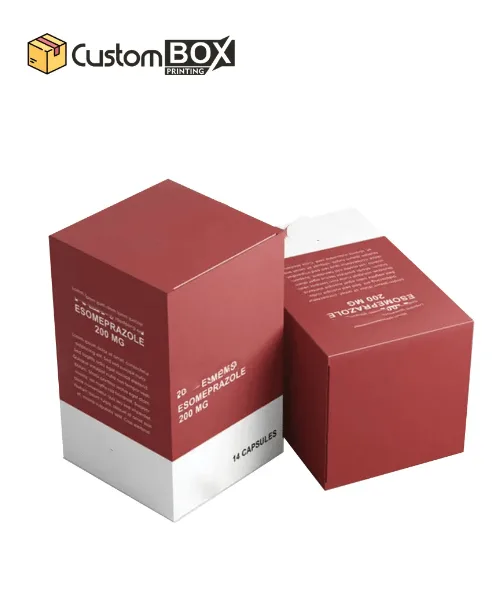
- Pill bottles (softgel, capsule, gummy, chewable) use a folding tuck-end carton sized to the bottle. See vitamin bottle boxes, softgel boxes, or capsule boxes.
- Gummies benefit from a front window to show color — see gummy supplement boxes.
- Powders (protein, greens, pre-workout) need a heavier auto-bottom carton for the tub weight — see protein powder boxes.
- Liquids (tinctures, functional serums, oils) use a slim tall reverse tuck-end — see tincture boxes and dropper bottle boxes.
- Multi-format bundles (starter kits, protocols) use a sleeve-and-tray.
Step 2: know what belongs on the carton
An FDA-regulated dietary supplement carton needs a specific set of elements. You write the copy; we route the dieline with room for it:
- Statement of identity (product name + delivery form)
- Supplement Facts panel (21 CFR 101.36)
- Ingredient statement / other ingredients
- Net contents (weight or count)
- US manufacturer, packer, or distributor address (21 CFR 101.5)
- Batch or lot code + expiration date (usually a hot-stamp zone)
- UPC/EAN barcode
- Warnings your formula needs (allergens, "consult a doctor if pregnant," etc.)
- Structure/function claims with the required FDA disclaimer, if you use any
Small tip: matte lamination over the panel helps the 6-8 pt regulatory type read under harsh retail lighting.
Step 3: material choice — SBS or kraft
Two everyday choices for supplement outer cartons:
- SBS (solid bleached sulfate) — bright white surface, holds photograph-heavy front panels and dense Pantone colors. Default for most vitamin brands.
- Kraft — unbleached brown board, fits clean-label, plant-based, and natural-wellness lines. Prints cleanly with 1-2 spot colors + optional foil.
Board weight: 14-16 pt for standard bottle sizes; step up to 18 pt for 120-count glass bottles or 5 lb protein tubs that add real weight.
Step 4: budget, MOQ, and timeline
Launch numbers to plan around:
- MOQ: 100 cartons is the floor. Runs of 250 or 500 lower per-unit cost noticeably.
- Per-unit price: ~$2.30-$2.80 at 250 qty in 14-16 pt SBS reverse tuck-end. Drops toward $1.90 at 500+.
- Setup fees: zero plate, die, or setup fees regardless of run size.
- Turnaround: 8-10 US business days from artwork approval, including free contiguous-US shipping.
- Free extras: free 3D digital mockup for your approval; physical sample (refunded on your first order) on larger runs (cost refunded on the production order).
Step 5: launch playbook
- Send your bottle spec or a sample bottle.
- Send your approved artwork (Supplement Facts, ingredients, warnings, brand front panel).
- We build a free dieline and 3D mockup within 1 US business day.
- You approve. We print. Boxes ship in 8-10 business days.
- Reorder at higher MOQ once your first run validates the SKU.
Related packaging and guides
- Hub: custom supplement boxes
- Adjacent: medicine boxes, nutraceutical boxes
- For CBD products, see how to choose CBD packaging
- For fast-launch box economics, see custom boxes with low MOQ
Ordering custom boxes — common questions
What is the minimum order for custom boxes?
Runs start at 100 units for folding cartons (cosmetic, food, bakery, CBD, mailer), 50 units for rigid setup boxes, and 5,000 units for printed paper (deli, butcher, tissue, kraft, sandwich wrap). No die, plate, or setup fees at any quantity.
Do you ship custom boxes free in the US?
Yes — standard shipping is free anywhere in the contiguous United States on every order. Rush production (3–5 business days) and expedited shipping are available for an additional fee.
How long does a custom box order take?
Typical timeline is 1 business day for a quote, 1–2 days to approve a free 3D digital mockup, then 7–10 business days for production plus 2–5 business days for free US shipping. Rush production is available on request.
Can I see a sample before I commit to a full order?
Yes — free 3D digital mockup with every quote, and a physical sample on request (refunded on your first order) before you place a production run. You can also design and preview your box live in our free 3D box designer.
What artwork files do you need to start printing?
Print-ready PDF, AI, EPS, or PSD at 300 DPI in CMYK with 0.125" bleed is ideal. Don't have artwork? Our in-house design team builds your dieline and preps files at no cost — just send your logo and any brand references.
Do you charge setup, plate, or die-cutting fees?
No — there are no setup, plate, die, or tooling fees at any quantity. Custom dielines, artwork prep, 3D mockups, and physical samples are all included free with every order.