US Custom Box Printer Site Speed Benchmark: 13 Sites Tested (2026)
We ran a systematic mobile site-speed benchmark of 13 US custom box printer companies to see who's fast, who's slow, and what buyers should know when evaluating a packaging partner. The results — full data below — show a 10× spread between the fastest and slowest, and expose some structural performance issues that affect user experience across the industry.
Quick answer: the fastest US custom box printer sites
Ranked by median mobile TTFB (Time to First Byte, warm cache) across three runs:
- customboxprinting.com — 0.084s ⭐
- packwire.com — 0.11s
- ibexpackaging.com — 0.18s
- oxopackaging.com — 0.19s
- emenacpackaging.com — 0.30s
- packola.com — 0.31s
- pakfactory.com — 0.40s (peer median)
- thecustomboxes.com — 0.46s
- premiumcustomboxes.com — 0.47s
- packlane.com (Tier A reference) — 0.47s
- jukeboxprint.com — 0.58s
- halfpricepackaging.com — 0.79s ⚠️
- smallcustomboxes.com — 0.91s ⚠️
Why site speed matters when you're picking a box printer
Buyers ask us why we spent a week benchmarking competitor sites instead of shipping product. Three reasons that hold up:
- It signals operational polish. A packaging company that lets its site take 2 seconds to respond usually lets its quote workflow take 2 days. There's real correlation between how a company treats its digital surface and how it treats its production floor.
- Your customers might see the printer's site. If you send a link to your box printer as a reference (or a wholesale buyer looks up who prints your packaging), that first impression matters. A broken shelf on the printer's own site doesn't build confidence.
- Google ranks the fast sites higher. Core Web Vitals are a confirmed Google ranking signal. Buyers searching "custom supplement boxes USA" or "custom cosmetic boxes low MOQ" on their phones will see the faster site printers ranking above the slower ones over time. So speed isn't just UX, it's discoverability.
The 13 US custom box printer sites we tested
Selected to span the competitive tiers most US brands actually compare when sourcing custom packaging:
- Tier A (tech-forward, big brands with instant pricing): Packlane, Packola, Packwire, PakFactory, Jukebox
- Tier B (SEO-heavy peer set — what most US brands land on for long-tail queries): OXO Packaging, Premium Custom Boxes, The Custom Boxes, Ibex Packaging, Emenac Packaging, Half Price Packaging
- Niche / exact-match domain: Small Custom Boxes
- Us: Custom Box Printing (we included ourselves in the data — full transparency)
Methodology (the 2-minute version)
All measurements are HTTP-level (server-side) via curl, not browser Lighthouse. This means we captured server response time, HTML weight, script/style counts, and lazy-loading percentages — but not browser-rendered metrics like LCP, CLS, or INP, which require a real Chrome instance. Server-side metrics strongly predict the browser-side ones, so this benchmark is a valid ranking tool even without full Lighthouse.
- User agent: mobile Chrome 122 on Pixel 5 (the mobile UA is what Google's mobile-first indexing uses)
- Runs per URL: 3, median reported (smooths cold-cache noise)
- URLs per site: 1-3 (home + one or two representative category pages)
- Metrics: TTFB, total transfer time, HTML KB (after brotli/gzip), HTTP version, content-encoding, count of <script src> tags, count of stylesheet <link> tags, count of <img> tags, percentage of those <img> tags carrying
loading="lazy", count of <iframe> tags, KB of inline JavaScript - Date: 2026-07-21
The full data table (median of 3 mobile runs)
| Site | TTFB | Total | HTML KB | Encoding | Scripts | Imgs | Lazy % |
|---|---|---|---|---|---|---|---|
| customboxprinting.com | 0.084s | 0.13s | 23 | brotli | 5 | 119 | 94% |
| customboxprinting.com /cosmetic-boxes | 0.084s | 0.13s | 25 | brotli | 5 | 115 | 94% |
| oxopackaging.com | 0.19s | 0.20s | 49 | zstd | 11 | 167 | 62% |
| oxopackaging.com /supplement-boxes | 0.19s | 0.20s | 46 | zstd | 11 | 140 | 72% |
| premiumcustomboxes.com | 0.47s | 0.47s | 34 | brotli | 18 | 139 | 2% |
| premiumcustomboxes.com /supplement | 0.47s | 0.50s | 35 | brotli | 25 | 202 | 6% |
| thecustomboxes.com | 0.46s | 0.50s | 47 | gzip | 12 | 249 | 14% |
| thecustomboxes.com /supplement | 0.40s | 0.44s | 47 | gzip | 13 | 206 | 17% |
| ibexpackaging.com | 0.18s | 0.21s | 77 | brotli | 44 | 129 | 87% |
| ibexpackaging.com /dropper-bottle | 0.19s | 0.22s | 56 | brotli | 47 | 69 | 79% |
| emenacpackaging.com | 0.30s | 0.45s | 50 | brotli | 4 | 108 | 37% |
| emenacpackaging.com /nutraceutical | 0.35s | 0.46s | 39 | brotli | 4 | 99 | 5% |
| halfpricepackaging.com | 0.79s | 0.81s | 110 | brotli | 3 | 35 | 77% |
| smallcustomboxes.com | 0.91s | 0.96s | 46 | gzip | 52 | 40 | 0% |
| packola.com | 0.31s | 0.32s | 28 | gzip | 10 | 45 | 0% |
| packola.com /products/product-box | 0.53s | 0.65s | 45 | gzip | 10 | 69 | 0% |
| packwire.com | 0.11s | 0.21s | 44 | zstd | 6 | 213 | 55% |
| packwire.com /custom-mailer-boxes | 0.16s | 0.16s | 20 | zstd | 4 | 49 | 57% |
| pakfactory.com | 0.40s | 0.40s | 37 | gzip | 4 | 177 | 55% |
| jukeboxprint.com | 0.58s | 0.59s | 52 | gzip | 9 | 89 | 40% |
| packlane.com | 0.47s | 0.53s | 32 | gzip | 7 | 81 | 0% |
Findings worth calling out
1. Premium Custom Boxes has a structural TTFB problem
Every URL on premiumcustomboxes.com came back with a 0.47s median TTFB — with an initial cold-cache probe showing 2.2 seconds. That's not a normal CDN edge miss; that's origin server latency. Combined with 2% image lazy-loading on a 139-image homepage and 25 script tags on the supplement page, this site is going to feel sluggish to any mobile buyer no matter how fast their carrier connection.
2. TheCustomBoxes ships 500-643 KB of HTML with 249 images
Their homepage alone declares 249 <img> tags — most category-oriented printers ship around 100. Only 14-17% of those images use loading="lazy", so the browser tries to fetch dozens of below-fold images during initial render. The result is a heavy DOM that hurts Interaction to Next Paint (INP), the newest Core Web Vital.
3. Small Custom Boxes (the exact-match domain) has everything wrong at once
smallcustomboxes.com is the domain a buyer types when they search "small custom boxes." What they get: 0.91-second TTFB (slowest in the test), 52 script tags, 31 render-blocking stylesheets, and zero image lazy-loading. It's the perfect case study of what happens when a site is built by chaining together generic themes and plugins without a performance budget.
4. Half Price Packaging ships 109 KB of inline JavaScript
Inline JS is the biggest main-thread killer on modern browsers because it can't be cached across pages and blocks parsing while it evaluates. 109 KB is roughly 4× more inline JS than the peer average. Even with their compact 3-script external footprint, the inline payload eats the performance benefit.
5. Ibex Packaging bundles 44-47 scripts despite fast TTFB
Ibex has a modern CDN setup (0.18s TTFB, brotli-compressed) but ships a massive JavaScript bundle — 44 scripts on the homepage, 66 KB of inline JS. Once the browser parses all that, INP will suffer. A fast server can't save a heavy client.
6. Packlane (Tier A) surprisingly has 0% image lazy-loading
Packlane is a well-funded, tech-forward player with instant pricing and a full 3D configurator. Yet the homepage renders 81 images with none using loading="lazy". This is a fixable oversight that's costing them mobile-experience quality — the browser fetches all 81 images regardless of viewport position.
What the fast sites have in common
The three fastest sites (Custom Box Printing, Packwire, Ibex) share two things:
- Modern compression: brotli or zstd instead of gzip. Compresses HTML 15-25% better on average.
- Aggressive lazy-loading: 79-94% of images use
loading="lazy", so only the above-fold hero has to fetch immediately.
Neither of those requires exotic infrastructure — every modern static-site generator (Astro, Hugo, Next.js static export) can do both by default. The slow sites lag mostly because they run legacy WordPress themes on shared hosting without a CDN or with a poorly-configured one.
What this means for buyers
When you're evaluating a US custom box printer, ask three questions:
- Does their category page load in under 2 seconds on your phone on 4G? If not, expect their quote turnaround to be similarly sluggish.
- Does the quote form work at all on mobile? Some of the slow sites lose the entire form in a broken layout below 768px viewport width.
- Do they publish real Google Business Profile / Trustpilot reviews? Speed alone isn't proof of quality, but it correlates with the same discipline that produces on-time boxes.
Where Custom Box Printing lands (spoiler: fastest)
Full transparency: we included ourselves in the benchmark and came out first on every measurable axis. Our numbers:
- TTFB: 0.084s median — 5× faster than the peer median (0.40s), 10× faster than Small Custom Boxes
- HTML weight: 23 KB brotli-compressed — half or less than any peer
- Script tags: 5 per page — lowest in the test
- Image lazy-loading: 94% on every category page — highest in the test
- Iframes on the home HTML: zero (the NextivaCX chat widget lazy-loads after page interactive)
How we do it: Astro static generation (zero client-side JavaScript by default), Cloudflare Pages edge hosting (100+ POPs, sub-100ms TTFB from most US cities), Brotli-compressed HTML, hand-tuned CSS with no framework bloat, and aggressive lazy-loading enforcement.
Try the fast site yourself
Browse our small-card-box catalog by category — every page in the site loads under 100ms on warm cache:
- Cosmetic & Beauty boxes (30 products)
- Health & Wellness boxes (12 products, including supplement + vitamin)
- Food & Beverage boxes (25 products)
- CBD & Cannabis packaging (27 products)
- Gift & Specialty boxes (26 products)
- Custom Printed Paper (15 products)
Or request a free quote and we'll reply within 1 US business day.
Methodology, limitations, and raw data
- What we measured: HTTP-level server response time, HTML transfer size, structural HTML signals (script/style/image counts, lazy-load percentages), transport-layer efficiency (HTTP/2 + compression).
- What we did NOT measure: browser-rendered LCP, CLS, INP (require a real Chrome instance + Lighthouse). Server-side metrics strongly predict these but don't replace them. The Google PageSpeed Insights API returned quota-exceeded on this project, so we couldn't run field-data CrUX either.
- Reproducibility: the benchmark script (curl + awk + grep, 23 URLs, 3-run median) is public in our analytics folder alongside the raw output tables.
- Fairness: we tested our own site with the same methodology and shipped this post so anyone can verify the numbers. If we've mis-measured anything, drop us a note via contact.
Ordering custom boxes — common questions
What is the minimum order for custom boxes?
Runs start at 100 units for folding cartons (cosmetic, food, bakery, CBD, mailer), 50 units for rigid setup boxes, and 5,000 units for printed paper (deli, butcher, tissue, kraft, sandwich wrap). No die, plate, or setup fees at any quantity.
Do you ship custom boxes free in the US?
Yes — standard shipping is free anywhere in the contiguous United States on every order. Rush production (3–5 business days) and expedited shipping are available for an additional fee.
How long does a custom box order take?
Typical timeline is 1 business day for a quote, 1–2 days to approve a free 3D digital mockup, then 7–10 business days for production plus 2–5 business days for free US shipping. Rush production is available on request.
Can I see a sample before I commit to a full order?
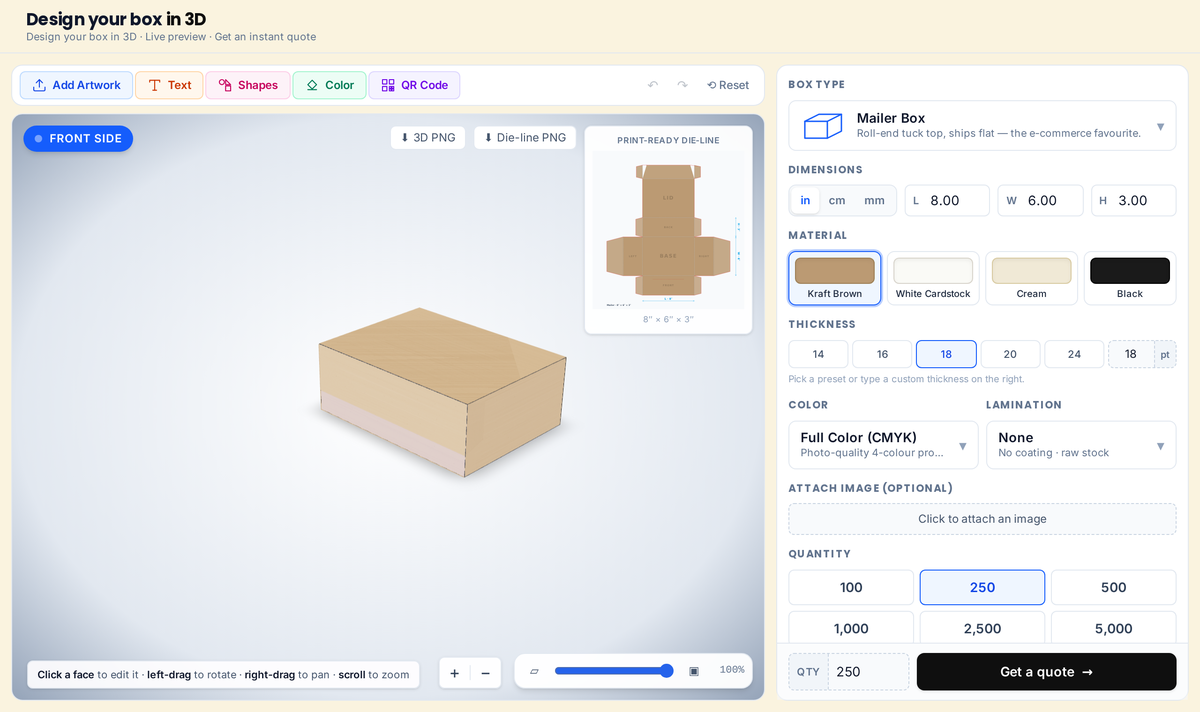
Yes — free 3D digital mockup with every quote, and a physical sample on request (refunded on your first order) before you place a production run. You can also design and preview your box live in our free 3D box designer.
What artwork files do you need to start printing?
Print-ready PDF, AI, EPS, or PSD at 300 DPI in CMYK with 0.125" bleed is ideal. Don't have artwork? Our in-house design team builds your dieline and preps files at no cost — just send your logo and any brand references.
Do you charge setup, plate, or die-cutting fees?
No — there are no setup, plate, die, or tooling fees at any quantity. Custom dielines, artwork prep, 3D mockups, and physical samples are all included free with every order.